IELTS EOR vs One Skill Retake which should you choose is a real decision for candidates who miss their target score by a small margin. The wrong choice can waste money, delay a visa or university application, and leave you with the same weak section later. Before you pay for either option, take the IELTS Express Pre-Test to check whether your result looks like a marking issue, a single-section problem, or a wider preparation gap.
The short answer is this: choose an Enquiry on Results when you believe your score may have been under-marked, especially in Writing or Speaking. Choose One Skill Retake when one section is clearly below your requirement and you are ready to sit that section again. Both options can help, but they solve different problems.
What IELTS EOR Means
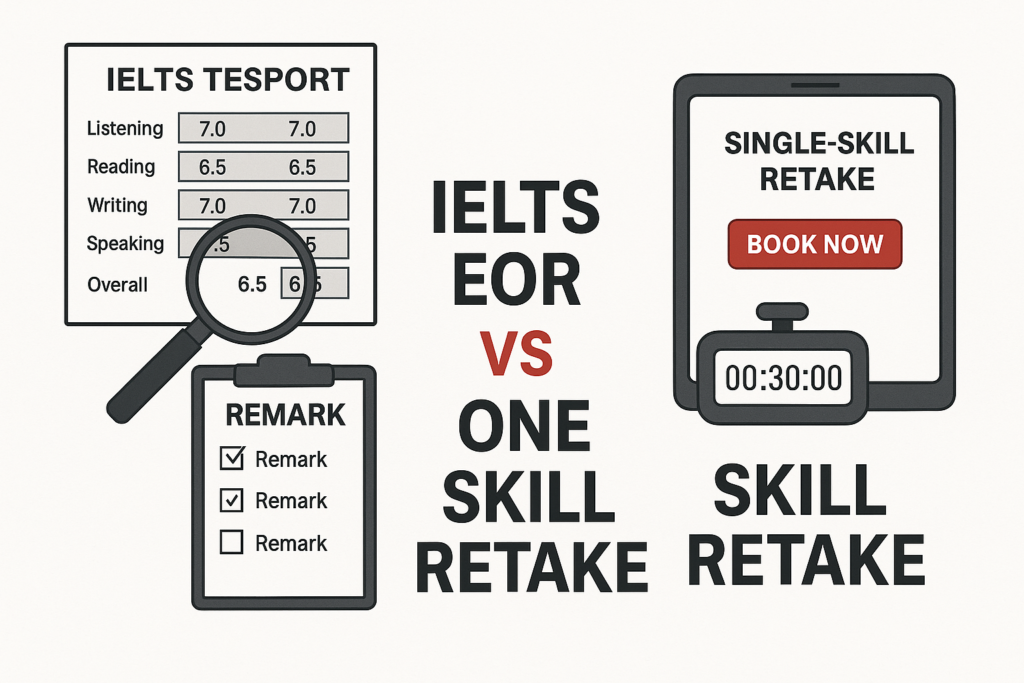
EOR means Enquiry on Results. It is a formal request for your IELTS test to be re-marked. You are not sitting the test again. Instead, your score is reviewed by a senior examiner or marking process, depending on the test provider and skill.
An EOR is most relevant when you think the original mark may not reflect your performance. This is usually considered for Writing or Speaking, because those sections involve examiner judgement. Listening and Reading are more objective because answers are marked against fixed answer keys, so score changes are less common.
- You keep the original test date.
- You ask for one or more skills to be reviewed.
- Your score can go up, stay the same, or in some cases be confirmed.
- You do not get extra time or a chance to rewrite your answers.
- If your score changes upward, you may receive an updated result.
What One Skill Retake Means
One Skill Retake lets eligible candidates retake only one IELTS skill rather than the full four-skill test. For example, if you achieved Listening 8, Reading 8, Speaking 7, and Writing 6.5, but you needed 7 in each band, you may be able to retake Writing only.
This option is practical when one section is the clear problem. It gives you a fresh attempt at that skill, with a new performance on a new test day. It does not change the original answer. It gives you the chance to produce a stronger answer under test conditions.
IELTS EOR vs One Skill Retake Which Should You Choose?
The best choice depends on why your score was low. If your result is surprising and you genuinely performed better than the score suggests, EOR may be worth considering. If the low result matches your practice scores, One Skill Retake is usually more logical because it addresses the actual weakness.
Think of EOR as a review of the past and One Skill Retake as a new attempt. EOR asks, was this score marked correctly? One Skill Retake asks, can I now perform better in this skill? Those are very different questions.
When EOR Is The Better Choice
EOR is more attractive when you missed your target by 0.5 in Writing or Speaking and your preparation history suggests you normally perform at the higher band. For example, if you repeatedly received Band 7 feedback in Writing practice but your official score was 6.5, a review may be reasonable.
It can also make sense when your deadline is tight and you cannot prepare properly for another sitting. EOR does not require another test-day performance. However, it is not a strategy for fixing weak English. If the original answer had unclear ideas, weak grammar, or poor task response, a review is unlikely to solve the problem.
When One Skill Retake Is The Better Choice
One Skill Retake is better when you know the weak section needs a fresh attempt. This is common for Writing, where candidates often lose marks for task response, paragraphing, sentence control, or unclear development. It is also useful for Speaking if your test-day fluency dropped because of nerves or unfamiliar topics.
If you choose this route, practise the exact skill under timed conditions before booking. Do not assume one more attempt will automatically be better. Use unlimited IELTS mock tests to check whether your score is stable enough before you pay for a retake.
Cost And Risk Comparison
Both options cost money, but the risk is different. With EOR, the risk is that you pay and the score stays the same. With One Skill Retake, the risk is that you sit again and still do not reach the required band. The right question is not only which option is cheaper. The better question is which option has the stronger reason behind it.
If your practice evidence supports a higher score, EOR may be a sensible first move. If your practice evidence shows the same weakness again and again, spending money on a review may only delay the training you need. In that case, review your preparation options and see our IELTS preparation plans before booking another attempt.
Timing And Deadline Pressure
Deadlines matter. Migration, university, nursing registration, and professional assessment timelines can make this decision more stressful. If your deadline allows only a short window, check the processing time for EOR and the available dates for One Skill Retake before choosing.
Do not rely on the fastest possible outcome. Build in a buffer where you can. A candidate who needs 7 in each band should plan for a possible second step. For broader planning, the IELTS retake policy guide can help you think through timing more carefully.
Writing Scores Need Special Care
Writing is the section where many candidates feel uncertain. A 6.5 can feel close to 7, but that does not mean it was a marking error. It may mean the answer was clear in parts but still had problems with development, cohesion, grammar range, or accuracy.
Before choosing EOR, look at your recent Writing feedback. Were your essays consistently Band 7 quality, or were they often around 6.5? If you do not have reliable feedback, One Skill Retake after focused correction may be safer than hoping a review changes the score.
Speaking Scores And Test-Day Performance
Speaking can vary because nerves, topic familiarity, and examiner interaction affect performance. If you are normally fluent but froze on test day, One Skill Retake may give you a fairer chance to show your real level. If you spoke confidently and still received a lower score than expected, EOR may be worth considering.
Be honest about the cause. If your answers were short, repetitive, or heavily memorised, a review is unlikely to help. If your fluency and pronunciation were strong but the score looks unusually low, a review may be reasonable.
Listening And Reading Are Usually Different
Listening and Reading are marked from fixed answers, so EOR is usually less promising for these sections. A score change is possible only in unusual circumstances, such as a technical or recording issue, but most candidates should treat the result as accurate.
If Listening or Reading is the missing band, One Skill Retake or a full retake is usually the more practical option. Work on question type, spelling, distractors, paraphrase recognition, and time control. The IELTS band score framework can help you identify whether your issue is accuracy, timing, or consistency.
A Simple Decision Framework
Start with evidence. Compare your official score with your last three practice results or teacher-marked tasks. If the official score is clearly below reliable practice evidence, EOR may be worth considering. If the official score matches your practice pattern, prepare for One Skill Retake instead.
Then check eligibility, deadline, cost, and emotional readiness. A retake requires another test-day performance, so you need enough time to practise. An EOR requires patience and acceptance that the result may not change. Neither option should be chosen only because you feel frustrated.
Common Mistakes Candidates Make
The first mistake is requesting EOR because the score is disappointing, not because there is evidence of under-marking. Disappointment is understandable, but it is not a strategy. The second mistake is booking One Skill Retake immediately without correcting the cause of the low score.
The third mistake is ignoring section minimums. Many migration and professional pathways require a minimum in each band. A higher overall score may not help if one section remains below the required level. Always check the exact score rule for your purpose before choosing your next step.
Final Recommendation
If you missed by 0.5 in Writing or Speaking and have strong evidence that you normally perform at the higher band, consider EOR first. If your weak skill has been unstable or consistently below target, choose One Skill Retake after focused preparation. If more than one skill is weak, a full retake or a longer preparation plan may be more sensible.
The best decision is the one that matches the problem. EOR is for possible marking mismatch. One Skill Retake is for a fresh performance in one weak skill. Use your evidence, your deadline, and your target band to choose calmly.
Ready to find out your IELTS band score?
Take the IELTS Express Pre-Test for just $4.99 and get your personalised band prediction with a 14-day improvement plan.
FAQ: IELTS EOR vs One Skill Retake
Is EOR better than One Skill Retake?
EOR is better if there is a realistic chance your Writing or Speaking score was under-marked. One Skill Retake is better if you need a fresh attempt at one weak skill.
Can my IELTS score go down after EOR?
Policies can vary by test provider, but candidates should treat EOR as a formal review, not a guaranteed increase. Check the provider rules before submitting the request.
Should I request EOR for Reading or Listening?
Usually no. Reading and Listening are marked against fixed answers, so One Skill Retake or further practice is normally more practical if either section is below target.
Is One Skill Retake accepted for visas or universities?
Acceptance depends on the organisation, course, visa pathway, or assessing authority. Always check the exact rule before relying on a One Skill Retake result.
What if I missed my score by 0.5 in Writing?
If your recent Writing feedback consistently showed the higher band, EOR may be reasonable. If your practice essays were also near the lower band, targeted preparation and One Skill Retake may be safer.